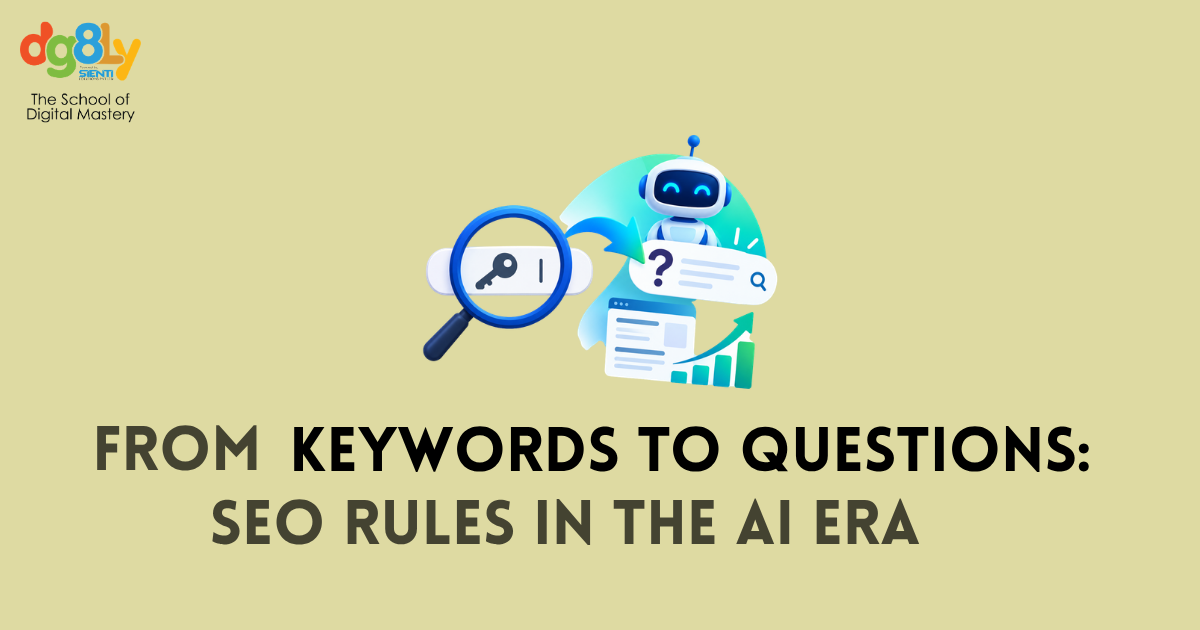
From Keywords to Questions: The New Rules of SEO in the AI Era
Introduction
Have you ever searched for something on Google and received an answer without visiting multiple websites? Artificial Intelligence (AI) is changing how people search for information online. Today, users increasingly ask complete questions and expect quick, relevant, and reliable answers.
Earlier, Search Engine Optimisation (SEO) focused heavily on keywords, backlinks, and publishing content regularly. These factors still matter, but modern SEO also requires businesses to understand what people want to know and provide genuinely helpful answers.
The new approach is simple: Stop creating content just to rank. Start creating content to solve problems.
Let's explore how businesses and beginners can adapt their SEO strategies in the AI era.
1. From Keywords to Questions: Understanding Search Intent
Keywords are the words and phrases people enter into search engines. Search intent refers to the reason behind a search.
For example, someone searching for "digital marketing course" may be exploring different courses. However, someone asking "How much does a digital marketing course cost in Kochi?" has a more specific requirement.
Understanding these questions helps businesses create content that matches what users actually need.
Instead of targeting only short keywords, consider the questions your potential customers ask before making a decision.
Beginner's tip: Before writing an article, ask yourself, "What problem is the reader trying to solve?"
2. Quality Matters More Than Content Quantity
Publishing more blog posts does not automatically improve search rankings. If several articles repeat the same information without offering anything useful, they may provide little additional value to readers.
AI-powered search makes it particularly important to create content that answers questions clearly and accurately.
For example, a digital marketing institute could publish ten similar articles about its courses. Alternatively, it could create a comprehensive guide explaining course fees, duration, practical training, career opportunities, and common mistakes to avoid when choosing a course.
The second approach may help prospective students make a more informed decision.
However, this does not mean that publishing fewer pages is always better. Different topics deserve separate articles when they address distinct questions in sufficient depth.
Remember: Focus on relevance, accuracy, usefulness, and originality rather than publishing content simply to increase your article count.
3. AI Search Is Changing How People Find Information
Traditional search engines typically display a list of links related to a search query. AI-powered search experiences can also summarise information and provide conversational answers.
Users may now ask questions such as:
Which digital marketing skills are useful for beginners?
How long does it take to learn SEO?
What is the difference between traditional SEO and AI search optimisation?
How can a small business improve its visibility on Google?
These questions require more than a page filled with keywords. They require clear explanations supported by relevant information.
Businesses should therefore create content that answers specific questions, explains important concepts, and helps users understand their options.
Although AI search creates new opportunities, appearing in AI-generated answers is not guaranteed. Strong content should serve readers first while following established SEO practices.
4. Answer the Questions Customers Actually Ask
One practical way to improve your content strategy is to understand the questions customers ask before purchasing a product or service.
For example, a customer researching a digital marketing course may want to know:
Cost: What are the course fees, and what do they include?
Timelines: How long does the course take to complete?
Financing: Are instalment payments or other payment options available?
Career opportunities: What skills will I learn, and what career paths could those skills support?
Mistakes to avoid: What should I check before choosing a training institute?
Answering these questions helps readers evaluate their options and builds trust in your business.
The same principle applies to other industries. A solar installation company could explain installation costs, available subsidies, maintenance requirements, savings estimates, and common installation mistakes.
When content addresses genuine customer concerns, it becomes a useful resource rather than just another promotional page.
5. Use Natural Language Instead of Stuffing Keywords
Keyword stuffing means repeating the same keyword excessively in an attempt to improve search rankings. This practice can make content difficult to read and does not guarantee better visibility.
Modern SEO requires a more natural approach.
Suppose your target keyword is "SEO course in Kochi."
Instead of repeating this phrase in every paragraph, you could answer related questions:
What is SEO, and why is it important?
What skills do students learn in an SEO course?
How can beginners practise SEO?
What tools are commonly used by SEO professionals?
These related topics provide context and help readers understand the subject more completely.
Use your main keyword naturally in the title, introduction, relevant headings, and other appropriate locations. Include related terms where they genuinely fit.
The goal is to write for people first, while making your content easy for search engines to understand.
6. Create Content That Builds Trust
In the AI era, publishing information is easier than ever. However, producing reliable, useful content still requires effort.
Businesses should demonstrate their expertise through accurate explanations, practical examples, original insights, and evidence that supports their claims.
For a digital marketing institute, useful trust-building content might include:
Real student projects and practical assignments.
Detailed explanations of SEO techniques.
Examples of website optimisation.
Honest discussions about career opportunities.
Experienced trainers sharing practical knowledge.
Updated information about search engine guidelines.
Avoid making unsupported promises, such as guaranteeing first-page rankings or a particular salary after completing a course.
Trust develops when content gives readers realistic expectations and helps them make informed decisions.
7. Make Your Content Easy to Read and Understand
Even valuable information can be difficult to use if it is poorly organised.
A well-structured article helps readers find the answers they need quickly.
Follow these simple practices:
- Use descriptive headings: Divide your article into sections that clearly explain what each section covers.
- Keep paragraphs concise: Present one main idea at a time.
- Answer questions directly: Give readers a clear answer before adding supporting details.
- Use examples: Explain unfamiliar concepts through practical situations.
- Add FAQs when useful: Address relevant questions that are not fully covered in the main article.
- Keep information updated: Review facts, prices, statistics, and guidelines when they change.
These practices improve readability and help search engines interpret your content. However, adding FAQs or using a particular format does not automatically guarantee rankings or inclusion in AI-generated answers.
8. How Beginners Can Optimise Content for AI Search
You do not need to be an AI expert to improve your SEO strategy. Start with these practical steps:
- Research your audience: Identify the questions your customers ask before making decisions.
- Choose a relevant topic: Focus on a genuine problem rather than selecting a keyword solely because it has search volume.
- Create a clear answer: Explain the topic accurately and in sufficient detail.
- Add practical value: Include examples, comparisons, original insights, and useful recommendations.
- Apply basic on-page SEO: Optimise your title, headings, URL, and meta description appropriately.
- Build website credibility: Provide transparent business information and demonstrate relevant expertise.
- Improve technical SEO: Ensure that search engines can access your important pages and that your website works well on mobile devices.
- Measure performance: Monitor relevant metrics through tools such as Google Search Console and Google Analytics.
Most importantly, do not assume that AI search replaces traditional SEO. A strong SEO foundation remains important, while content should also meet users' needs in conversational and AI-assisted search experiences.
Conclusion: The Future of SEO Starts with Better Answers
The evolution of search is changing how businesses approach content creation. Success is not simply about publishing more articles or inserting keywords into every paragraph. It is about understanding user intent, answering meaningful questions, building trust, and delivering genuine value.
For beginners, learning these principles is an important step towards developing practical digital marketing skills. Understanding keyword research, search intent, content optimisation, technical SEO, and AI-driven search experiences can help you prepare for the changing digital landscape.
If you want to develop these skills through structured learning and practical training, choosing the right institute is an important first step. Look for a programme that covers SEO fundamentals, real-world projects, current industry practices, and the evolving role of AI in search.
If you are looking for the best SEO course in Kochi, choose a training programme that helps you move beyond memorising keywords and teaches you how to understand users, solve real problems, and create content that deserves to be found.

