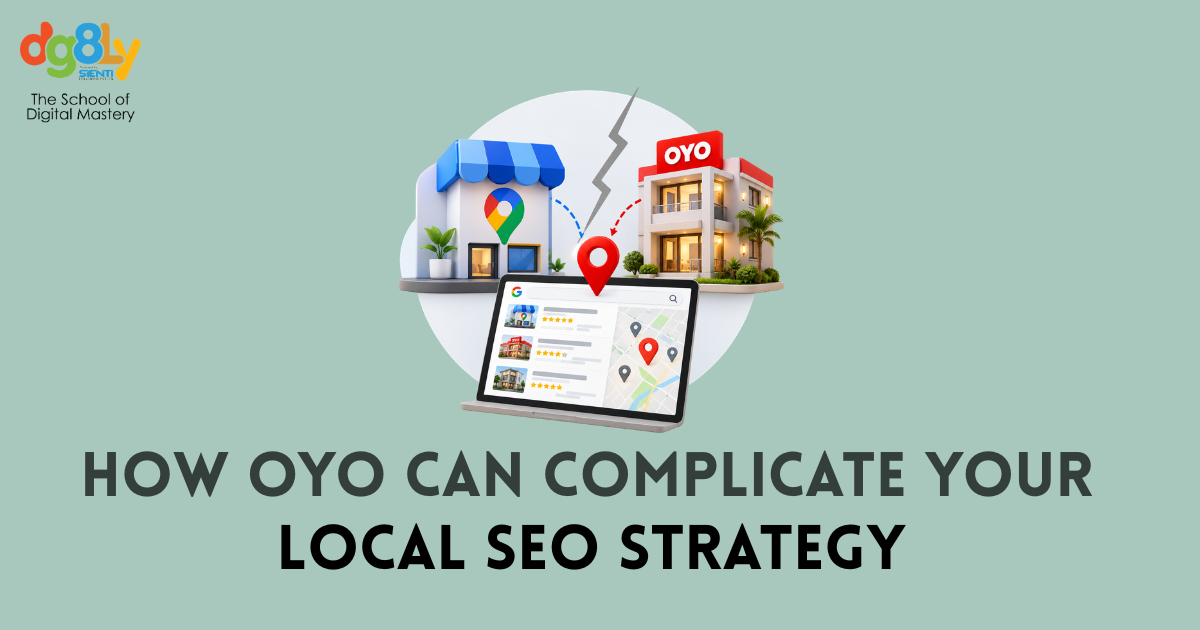
How Platforms Like OYO Can Complicate Your Local SEO Strategy
Introduction
Imagine you own a hotel in Kochi. You have a Google Business Profile, a website, and a good reputation among your customers. You want people searching for hotels in Kochi to find your business on Google.
To attract more customers, you partner with a third-party platform like OYO. Initially, everything seems fine. You receive bookings, reach new customers, and improve your online visibility.
But have you ever wondered what happens when customers find different phone numbers, addresses, business names, or booking options across multiple platforms?
This is where local SEO becomes important.
Third-party platforms can help businesses reach a wider audience. However, depending too heavily on them without managing your own online presence can create challenges. Understanding these challenges is essential for business owners who want to maintain control over their digital identity.
Let's explore how platforms like OYO can complicate your local SEO strategy and what you can do to avoid common mistakes.
What Is Local SEO?
Local SEO, or Local Search Engine Optimisation, is the process of improving your business's visibility in search results for location-based searches.
For example, when someone searches for:
Best hotel in Kochi
Restaurants near Kakkanad
Digital marketing institute in Kochi
Best salon near me
Google displays results that it considers relevant to the search. These may include Google Maps listings, business profiles, websites, and other local results.
Google considers three primary factors when determining local rankings:
1. Relevance: How closely a business matches what someone is searching for.
2. Distance: How far the business is from the searcher's location or the location specified in the search.
3. Prominence: How well-known a business is, based on information Google has about it, including factors such as links and reviews.
A well-managed Google Business Profile can help customers discover your business. However, your local SEO strategy should extend beyond your profile to include your website, reputation, and presence across relevant platforms.
What Are Third-Party Aggregators?
Third-party aggregators are platforms that connect businesses with potential customers through their own websites or applications.
Examples include:
OYO for hotel bookings
Swiggy and Zomato for food discovery and delivery
Justdial for business discovery
Booking.com for accommodation reservations
These platforms can help businesses reach customers who might not otherwise discover them.
For example, a small hotel in Kochi may receive bookings from travellers who find it through OYO rather than through a direct Google search.
The challenge begins when a business becomes so dependent on third-party platforms that it neglects its own website, Google Business Profile, and customer relationships.
The objective is not to avoid aggregators. It is to use them without losing control of your own digital presence.
1. Your Business Information May Become Inconsistent
Imagine a hotel named Green Valley Residency in Kochi.
Its Google Business Profile displays one phone number, while its website displays another. A third-party platform lists a slightly different business name, and an outdated directory shows an old address.
What happens when a customer encounters these differences?
The customer may become confused about which information is correct. They might call the wrong number, visit an outdated location, or struggle to contact the business directly.
From an SEO perspective, accurate and consistent business information helps Google and customers understand which business they are looking at.
However, inconsistent information does not automatically result in a ranking penalty. Its impact depends on the circumstances, including whether the discrepancies create genuine confusion about the business.
What should you do?
- Keep your business name accurate and consistent.
- Ensure your address and phone number are correct.
- Update your Google Business Profile when information changes.
- Check important third-party listings periodically.
- Correct outdated information wherever you have access to it.
Remember, maintaining accurate information is an important part of building customer trust and managing your local online presence.
2. You May Become Too Dependent on Third-Party Platforms
Consider a hotel that receives most of its bookings through OYO.
The hotel may gain visibility among travellers using the platform. However, if it neglects its own website and Google Business Profile, it may miss opportunities to attract customers through direct searches.
For example, someone searching for the hotel's name on Google might discover its website, Google Business Profile, and OYO booking page.
If the hotel has a useful website, accurate business information, and a properly managed Google Business Profile, customers have more opportunities to learn about the property and choose how to make a booking.
If its own digital presence is poorly maintained, customers may rely more heavily on third-party platforms for information and reservations.
This does not mean OYO automatically takes ownership of your Google Business Profile or damages your rankings. Rather, it highlights the importance of maintaining your own online assets.
How can you reduce this dependency?
Build your own digital presence.
Create and maintain an informative business website.
Optimise your Google Business Profile.
Publish accurate details about your services and facilities.
Encourage genuine customer reviews.
Provide clear contact information and direct booking options where appropriate.
Third-party platforms can be useful sources of customers, but your own digital presence should remain a priority.
3. Your Google Business Profile Is Not the Same as an Aggregator Listing
This is an important distinction for beginners to understand.
Your Google Business Profile is a business profile managed through Google's platform. It allows eligible businesses to manage their information and interact with customers on Google Search and Maps.
An aggregator listing, on the other hand, is a listing on a separate platform operated by another company.
For example, a hotel may have:
Its own website.
A Google Business Profile.
An OYO listing.
A Booking.com listing.
Listings on other travel websites.
These are separate digital assets, even when they represent the same hotel.
A hotel should not assume that maintaining an OYO listing automatically keeps its Google Business Profile accurate.
Similarly, an aggregator's listing does not automatically give that platform control of the hotel's Google Business Profile.
What is the risk?
Problems may arise when businesses fail to monitor their listings, allow outdated details to remain online, or do not understand who controls each account.
In some situations, businesses may also encounter duplicate or incorrectly represented profiles. These issues should be investigated and corrected through the appropriate platform.
Best practice
Maintain access to your own Google Business Profile and website. Review third-party listings regularly, and correct inaccurate information whenever possible.
If a Google Business Profile has been created incorrectly or someone else controls it, use Google's official ownership or access recovery process.
Your goal should be to maintain control of your business's legitimate digital assets, not to eliminate every third-party listing.
4. Duplicate Listings Can Create Confusion
Suppose a hotel has two Google Business Profiles: one created by the owner and another containing outdated information.
Customers may encounter different phone numbers, addresses, photos, or reviews.
This can make it harder for customers to identify the correct profile.
Duplicate profiles can also complicate reputation management and the maintenance of accurate business information.
However, not every similar-looking listing is a duplicate. For example, separate businesses operating at the same address may legitimately require separate profiles if they meet Google's eligibility requirements.
How can you prevent this problem?
Search Google Maps for your business name.
Check whether multiple profiles represent the same business.
Verify the accuracy of your existing profile before creating another.
Follow Google's guidelines for reporting or resolving duplicate profiles.
Avoid creating multiple profiles simply to improve visibility.
A clean and accurate business presence is more useful than multiple competing listings containing inconsistent information.
5. Customer Reviews Require Consistent Attention
Reviews play an important role in customer decision-making.
Imagine two hotels in Kochi offering similar facilities. One has recent, detailed reviews from genuine customers, while the other has very few reviews and has not received feedback for a long time.
A potential guest may feel more confident choosing the first hotel because its reviews provide useful information about recent customer experiences.
Google identifies review count and positive ratings as factors that can contribute to local prominence. However, businesses should not assume that receiving reviews at a particular speed or on a particular schedule guarantees better rankings.
Review velocity refers to the rate at which a business receives reviews. Review recency refers to how recently those reviews were posted.
Both are useful metrics for understanding customer feedback and maintaining an active reputation-management process.
What should businesses do?
Ask genuine customers to share honest feedback.
Make it easy for customers to leave reviews.
Respond professionally to positive and negative feedback.
Avoid purchasing reviews or offering incentives in exchange for positive reviews.
Monitor reviews across relevant platforms.
The objective is to build a trustworthy reputation through genuine customer experiences, rather than attempting to manipulate search rankings.
6. Why Your Own Website Still Matters
Many business owners believe that having a Google Business Profile and an aggregator listing is enough.
But a website provides additional opportunities to communicate directly with customers.
For example, a hotel website can include:
Detailed room descriptions.
Photographs of facilities.
Location and contact information.
Frequently asked questions.
Directions and nearby attractions.
Direct enquiry or booking options.
For a digital marketing institute in Kochi, a website can explain its courses, syllabus, practical training, faculty, student projects, and admission process.
This information helps potential customers understand the business before contacting it.
Your website also allows you to develop relevant content around the services and locations you serve.
When your website, Google Business Profile, and other legitimate listings provide accurate, consistent information, you create a stronger foundation for your local SEO strategy.
Remember that consistency alone does not guarantee rankings. Content quality, relevance, competition, and other factors also influence search visibility.
7. A Practical Checklist for Managing Your Local SEO
If you own a business in Kochi, use this simple checklist to review your online presence.
Task
What you should check
Google Business Profile
Verify ownership, access, business name, category, address, and phone number.
Business website
Keep service details, contact information, and location information accurate.
Third-party platforms
Review listings on relevant aggregators and correct outdated details.
Duplicate profiles
Identify and resolve genuine duplicate listings.
Customer reviews
Encourage genuine feedback and respond professionally.
Business information
Check for conflicting phone numbers, addresses, and names.
Website content
Publish useful content relevant to your services and target locations.
Performance tracking
Monitor calls, website visits, enquiries, and other meaningful outcomes.
Review this checklist periodically, particularly after changing your address, phone number, business name, or service details.
Conclusion: Take Control of Your Local SEO Strategy
Platforms like OYO, Booking.com, and other aggregators can help businesses reach new customers. The problem is not necessarily their presence, but the risk of becoming overly dependent on them while neglecting your own digital assets.
Businesses should maintain their Google Business Profile, build a useful website, keep their information accurate, manage customer reviews, and monitor their presence across third-party platforms.
For businesses in Kochi, understanding these principles is essential to developing a sustainable local SEO strategy. Local SEO is not simply about adding keywords to a website. It involves understanding how customers search, maintaining an accurate online presence, building trust, and making it easier for people to discover your business.
Want to master these practical SEO skills? Learning how Google Business Profile optimisation, local search, keyword research, website optimisation, and reputation management work together can help you develop valuable digital marketing skills.
If you are looking to build a career in this field, explore the best SEO course in Kochi to understand how modern SEO techniques can be applied to real businesses, improve local visibility, and support long-term digital growth.

