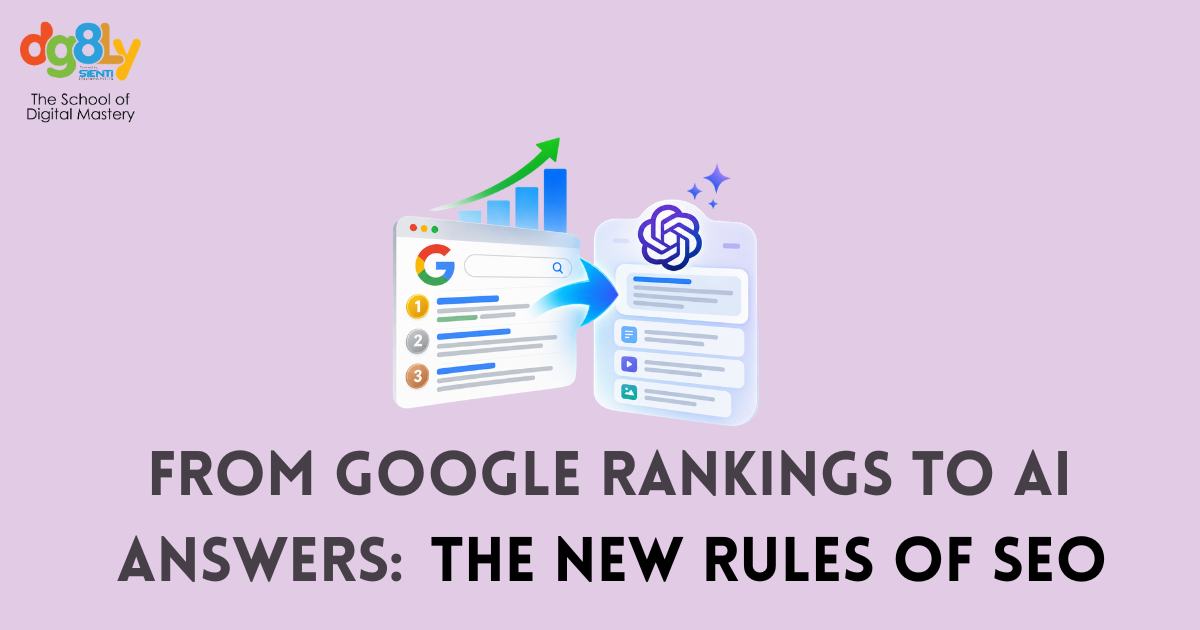
From Google Rankings to AI Answers: The New Rules of SEO
Introduction
Have you ever searched for something on Google and received an AI-generated answer before clicking on any website? This is how search is changing.
Earlier, Search Engine Optimisation (SEO) mainly focused on helping websites rank higher on Google. Today, people also use AI-powered tools such as ChatGPT, Google Gemini, and Google's AI Overviews to find information, compare products, and get answers to their questions.
This change does not mean traditional SEO is dead. Instead, SEO is evolving. Businesses now need to focus on both search engine rankings and creating content that AI-powered search experiences can understand, trust, and use.
Let's explore the new rules of SEO and understand how beginners can adapt to this changing digital landscape.
1. What Is Traditional SEO?
Search Engine Optimisation, commonly known as SEO, is the process of improving a website so that it can appear more prominently in organic search results.
For example, imagine someone searches for “best digital marketing institute in Kochi.” Google displays relevant websites based on several factors, including content quality, relevance, website experience, and authority.
Traditional SEO focuses on improving these factors through activities such as:
Keyword research: Finding the words and phrases people use when searching online.
On-page SEO: Optimising titles, headings, URLs, images, and website content.
Technical SEO: Making sure search engines can crawl, understand, and index a website.
Off-page SEO: Building website authority through relevant backlinks and other credible references.
Local SEO: Helping businesses appear in location-based searches and Google Maps.
The main goal is to make a website more relevant and accessible to people searching for its products, services, or information.
2. What Has Changed with AI-Powered Search?
Search behaviour is moving beyond short keywords towards more detailed questions and conversational queries.
Earlier, a user might search for “SEO courses in Kochi.” Today, that person might ask an AI tool, “Which SEO course in Kochi is suitable for a beginner who wants practical training?”
Traditional search engines primarily present a list of relevant web pages. AI-powered search experiences can also summarise information, explain concepts, and provide answers based on information from multiple sources.
For businesses, this creates a new opportunity. Their content needs to be useful not only for people browsing search results but also for systems that retrieve, interpret, and summarise information.
However, appearing in an AI-generated answer is not guaranteed. It depends on the platform, the query, the available sources, and other factors.
3. The Difference Between Traditional SEO and AI Search Visibility
Traditional SEO and AI search visibility have different goals, but they share many important practices.
Traditional SEO focuses on:
Improving organic search rankings.
Targeting relevant keywords.
Increasing qualified website traffic.
Improving website structure and technical performance.
Earning relevant backlinks and building authority.
AI search visibility focuses on:
Providing clear and direct answers to specific questions.
Organising content so its meaning is easy to understand.
Demonstrating experience, expertise, and credibility.
Supporting important claims with reliable information.
Creating useful content that may be retrieved or referenced by AI-powered systems.
The important point is that these approaches are not competitors. Strong traditional SEO practices can also support visibility in AI-powered search, although they do not guarantee inclusion in AI answers.
4. The New Rules of SEO in the AI Era
Rule 1: Answer the User's Question Directly
AI-powered search experiences often need clear information that addresses the user's question.
Avoid writing long introductions that delay the answer. Start each section with a simple, direct explanation and then provide supporting details.
For example, instead of beginning with several paragraphs about digital marketing, answer the question “What is local SEO?” immediately.
Example:
Local SEO is the process of improving a business's online visibility in location-based search results, helping nearby customers discover its products or services.
This approach improves readability and makes the content easier to understand.
Rule 2: Create Content Around Search Intent
Search intent means the reason behind a person's search.
A user searching for “what is SEO” probably wants to learn. Someone searching for “SEO course fees in Kochi” may be comparing courses before making a decision.
Understand what your audience wants before creating content.
You can identify relevant questions using tools such as Google Search, Google Search Console, Google Trends, and AnswerThePublic.
When your content matches the user's actual needs, it becomes more useful and relevant.
Rule 3: Use Clear Headings and Logical Structure
Headings help readers understand what each section covers. They also help search engines and AI-powered systems interpret the organisation of your content.
Use a clear heading hierarchy with one main H1 title, relevant H2 sections, and H3 subsections where necessary.
For example:
H1: The Beginner's Guide to Local SEO
H2: What Is Local SEO?
H2: Why Is Local SEO Important?
H2: How to Improve Local SEO
H3: Optimise Your Google Business Profile
Keep headings descriptive and relevant. Avoid adding keywords unnaturally just to attract search engines.
Rule 4: Focus on Experience, Expertise, Authoritativeness, and Trust
Trust is important in both traditional search and AI-driven information discovery.
Google's concept of E-E-A-T stands for Experience, Expertise, Authoritativeness, and Trustworthiness. It is a framework used to assess qualities associated with helpful, reliable content, rather than a single direct ranking factor.
Businesses can strengthen credibility by:
Sharing practical experience and original insights.
Publishing accurate and updated information.
Introducing the authors and their relevant expertise.
Supporting factual claims with trustworthy sources.
Maintaining accurate business information across online platforms.
Including genuine customer experiences where appropriate.
For example, a digital marketing institute can publish practical SEO case studies, explain the methods used, and share measurable results when those results can be verified.
Original experience can make content more valuable than a generic article repeating information available everywhere.
Rule 5: Write Naturally, Not Just for Keywords
Keywords remain important, but repeating the same phrase unnecessarily can make content difficult to read.
Instead, use the main keyword naturally and cover related concepts that help answer the reader's question.
For a blog targeting “SEO courses in Kochi,” relevant topics might include beginner training, practical projects, curriculum, course duration, and career opportunities.
Cover these subjects only when they are relevant and supported by accurate information.
The goal is not to fill a page with keywords. It is to provide a complete, helpful answer.
Rule 6: Strengthen Your Website's Technical SEO
Even excellent content needs a technically accessible website.
Important practices include:
Making sure important pages can be crawled and indexed.
Improving mobile usability and page loading performance.
Using descriptive URLs and internal links.
Adding relevant image alt text.
Implementing appropriate structured data where eligible.
Fixing broken links and duplicate content issues.
Structured data can help search engines understand specific information about a page, but it does not guarantee a special search appearance or inclusion in AI-generated answers.
There is also no single special file or markup that guarantees visibility across every AI search platform. Strong technical foundations remain essential.
Rule 7: Build Authority Beyond Your Website
People may discover a business through search engines, professional communities, social platforms, review sites, and other trusted sources.
Businesses should maintain accurate information and build a credible online presence through relevant industry contributions, useful content, genuine reviews, and quality backlinks.
For local businesses, a well-maintained Google Business Profile can help customers discover essential details such as services, location, contact information, and reviews.
Avoid buying low-quality backlinks or creating artificial mentions. Sustainable authority comes from relevance, credibility, and genuine value.
5. How Can You Optimise Content for AI Answers?
Imagine you are writing a blog about “How to Improve Local SEO.”
You can make the article more useful by following these steps:
Step 1: Identify real questions. Find out what your audience wants to know, such as how Google Business Profiles work or how local keywords are selected.
Step 2: Give direct answers. Address each question early in the relevant section.
Step 3: Add useful details. Include examples, step-by-step instructions, original observations, and credible sources.
Step 4: Organise the information. Use descriptive headings, short paragraphs, lists, and tables wherever they improve understanding.
Step 5: Demonstrate credibility. Keep the information accurate, identify the author where appropriate, and explain practical experience.
Step 6: Update and measure performance. Review outdated information and use available analytics and search performance data to understand what works.
Remember, writing content in this format can improve clarity and usefulness, but it cannot guarantee that an AI tool will select or cite your page.
6. How Can You Measure SEO Success in the AI Era?
Website rankings are still useful, but they are no longer the only measure worth considering.
Businesses can track several indicators to understand how people discover and interact with their content.
Organic impressions: How often pages appear in eligible search results.
Organic clicks: How many people visit the website through organic search.
Keyword performance: How relevant pages perform for important search queries.
Conversions: How many visitors complete meaningful actions, such as submitting an enquiry.
Referral traffic: Visits coming from other websites and identifiable referral sources.
AI visibility: Whether a brand or website appears in AI-generated answers, where such visibility can be reliably observed or measured.
Google Search Console remains useful for monitoring Google Search performance. Website analytics can help measure visits and conversions.
AI visibility measurement is still developing, and reporting differs across platforms. Therefore, businesses should avoid relying on a single metric or assuming that every AI-generated mention leads to website traffic.
7. What Does This Mean for SEO Beginners?
For beginners, this change is an opportunity to learn SEO more completely.
Instead of learning only keyword placement and backlink building, aspiring SEO professionals should understand search intent, content quality, technical SEO, local SEO, analytics, and AI-assisted search experiences.
Practical training is especially valuable. Working on a website, conducting keyword research, auditing pages, optimising a Google Business Profile, and analysing performance can help learners understand how SEO works in real situations.
AI tools can support research and content planning, but human judgement remains essential for checking accuracy, originality, relevance, and usefulness.
The future of SEO is not simply about using AI to create more content. It is about understanding people, providing trustworthy answers, and making information accessible to both users and search technologies.
Conclusion
SEO is evolving from a narrow focus on Google rankings towards a broader approach that considers how people discover information through traditional search engines and AI-powered answers. Businesses that combine strong technical SEO, helpful content, clear answers, genuine expertise, and credible online signals will be better prepared for these changes.
For aspiring digital marketers, this is the right time to strengthen SEO fundamentals while learning how AI is influencing search behaviour. Choosing practical training can help you build the skills needed to adapt to this evolving industry.
If you want to develop these skills through structured learning and hands-on practice, exploring the best digital marketing course in Kochi can be a valuable starting point for building your digital marketing career.

