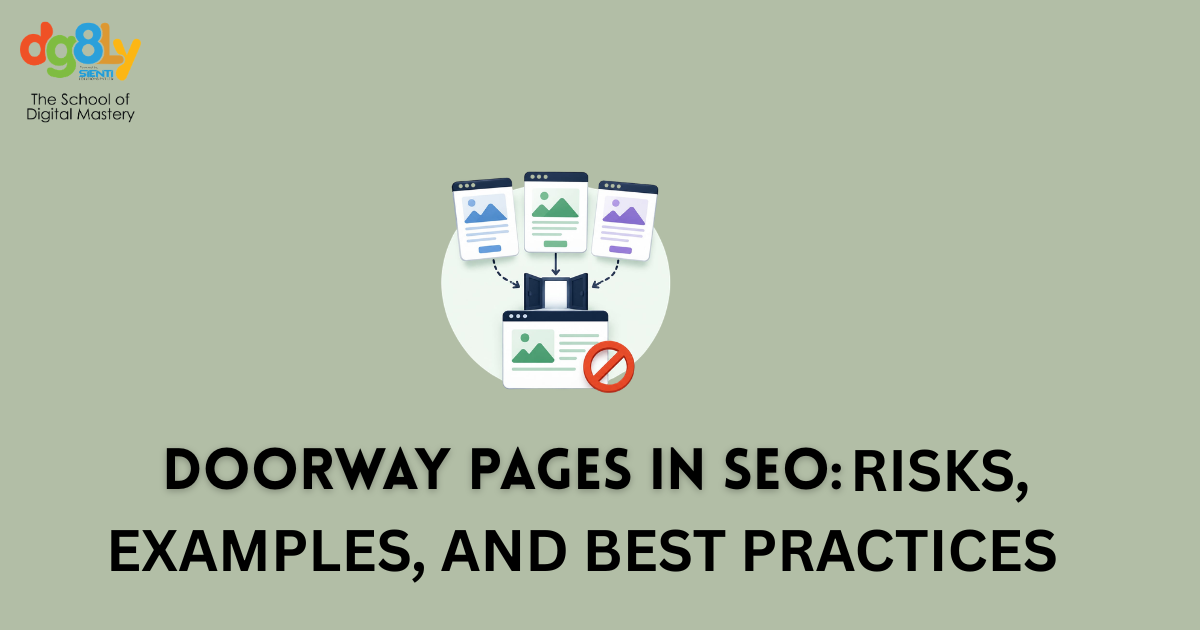
Doorway Pages in SEO: Risks, Examples, and Best Practices
If you're new to SEO, you've probably heard the term doorway pages. Some people believe they are a shortcut to ranking higher on Google. In reality, doorway pages are considered a spam technique and can seriously harm your website's search performance.
Google's spam policies clearly identify doorway pages as a violation because they are created primarily for search engines rather than for users. Instead of improving your rankings, they can lead to lower visibility or even manual penalties.
In this beginner-friendly guide, you'll learn what doorway pages are, why they're risky, real-world examples, and the best practices to avoid them.
What Are Doorway Pages?
A doorway page is a webpage created mainly to rank for specific keywords and direct visitors to another page instead of providing valuable information on its own.
These pages often look different only because they target different keywords, cities, or locations, while the actual content remains nearly identical.
Simple Example
Imagine you own a plumbing business serving multiple cities.
Instead of creating genuinely helpful pages, you publish:
Plumbing Services in Kochi
Plumbing Services in Ernakulam
Plumbing Services in Aluva
Plumbing Services in Thrippunithura
Each page contains almost the same content with only the city name changed. Every page sends users to the same contact form.
This is a classic example of a doorway page because each page exists mainly to capture search traffic rather than help visitors.
Why Are Doorway Pages Bad?
Search engines aim to provide users with the most relevant and useful result.
Doorway pages create a poor user experience because:
Users see multiple nearly identical pages in search results.
The pages provide little or no unique information.
Visitors are often redirected to another page.
The content is written mainly for search engines.
Google considers this a spam practice because it manipulates rankings without adding value.
Common Examples of Doorway Pages
1. Location-Based Duplicate Pages
A company creates hundreds of pages by changing only the city name.
Example:
SEO Services Kochi
SEO Services Thrissur
SEO Services Kozhikode
If every page contains the same content except the location, they may be treated as doorway pages.
2. Multiple Domains for the Same Business
A business buys several domains such as:
bestkochiplumber.com
kochiplumbingexpert.com
emergencyplumberkochi.com
All domains redirect visitors to one website.
3. Keyword Variation Pages
Creating separate pages like:
Cheap SEO Course
Affordable SEO Course
Low Cost SEO Course
when all pages have identical content.
4. Thin Affiliate Pages
Some affiliate websites create hundreds of pages targeting different keywords with very little original content before sending visitors elsewhere.
What Happens If You Use Doorway Pages?
Using doorway pages may lead to several problems.
1. Lower Google Rankings
Instead of ranking better, your pages may disappear from search results.
2. Manual Action
Google reviewers may manually penalize your website if they identify doorway pages.
3. Reduced Organic Traffic
As rankings decline, website visitors also decrease.
4. Poor User Experience
Visitors quickly leave because every page offers nearly the same information.
5. Loss of Trust
People are less likely to trust websites that appear repetitive or misleading.
How Google Detects Doorway Pages
Google looks for patterns such as:
Nearly identical pages targeting different keywords
Large numbers of thin pages
Pages with little unique value
Pages created only for search engines
Multiple pages leading users to the same destination
Google's spam systems have become increasingly effective at identifying these patterns.
Doorway Pages vs Legitimate Landing Pages
Many beginners confuse these two.
Legitimate Landing Page
Doorway Page
Unique content
Duplicate content
Helps users solve a problem
Exists mainly to rank
Different services or offers
Same offer repeated
Valuable local information
Only city names changed
Clear purpose
Funnels visitors elsewhere
A well-written landing page serves users first. A doorway page serves search engines first.
Best Practices to Avoid Doorway Pages
Create Unique Content
Every page should provide original information.
Instead of replacing only the city name, include:
Local customer testimonials
Area-specific services
Nearby landmarks
Local pricing
Frequently asked questions
Focus on User Intent
Ask yourself:
"Would this page still be useful if Google didn't exist?"
If the answer is yes, you're probably creating quality content.
Avoid Mass-Produced Pages
Don't generate hundreds of pages automatically just to target keyword variations.
Quality always beats quantity.
Combine Similar Pages
Instead of publishing ten nearly identical pages, create one comprehensive page that covers the topic thoroughly.
Improve Internal Linking
Help visitors navigate naturally through your website rather than forcing them through unnecessary pages.
Add Real Value
Every page should answer questions, solve problems, or provide useful information.
Signs You Might Have Doorway Pages
Check your website for these warning signs:
Multiple pages differ only by location names
Identical content across many URLs
Pages have very low traffic
Visitors leave immediately
Every page promotes the exact same service without unique details
If you notice these issues, it's time to update or consolidate your pages.
Is Programmatic SEO the Same as Doorway Pages?
No.
Programmatic SEO can be perfectly acceptable when every page provides unique, valuable information.
For example, a travel website with separate pages for every city can rank well if each page includes:
Local attractions
Hotels
Maps
Transportation
Weather
Travel tips
The difference is value. Pages that genuinely help users are not doorway pages simply because they follow a template.
Conclusion
Doorway pages may seem like an easy SEO shortcut, but they create a poor experience for users and violate Google's spam guidelines. Instead of building hundreds of near-duplicate pages, focus on creating unique, informative, and genuinely helpful content that answers your audience's questions.
Successful SEO is built on quality, trust, and user satisfaction. When every page on your website offers real value, you're more likely to earn sustainable rankings, attract qualified visitors, and grow your online presence over the long term.
Understanding doorway pages is essential for anyone starting their SEO journey. Avoid shortcuts that prioritize search engines over people, and invest your efforts in creating original, user-focused content that addresses real search intent. As search algorithms continue to reward helpful websites, ethical SEO practices will always outperform spam tactics in the long run. If you're looking to master these strategies and build a strong foundation in search engine optimization, enrolling in the best SEO course in Kochi can provide the practical knowledge and hands-on experience needed to succeed.

