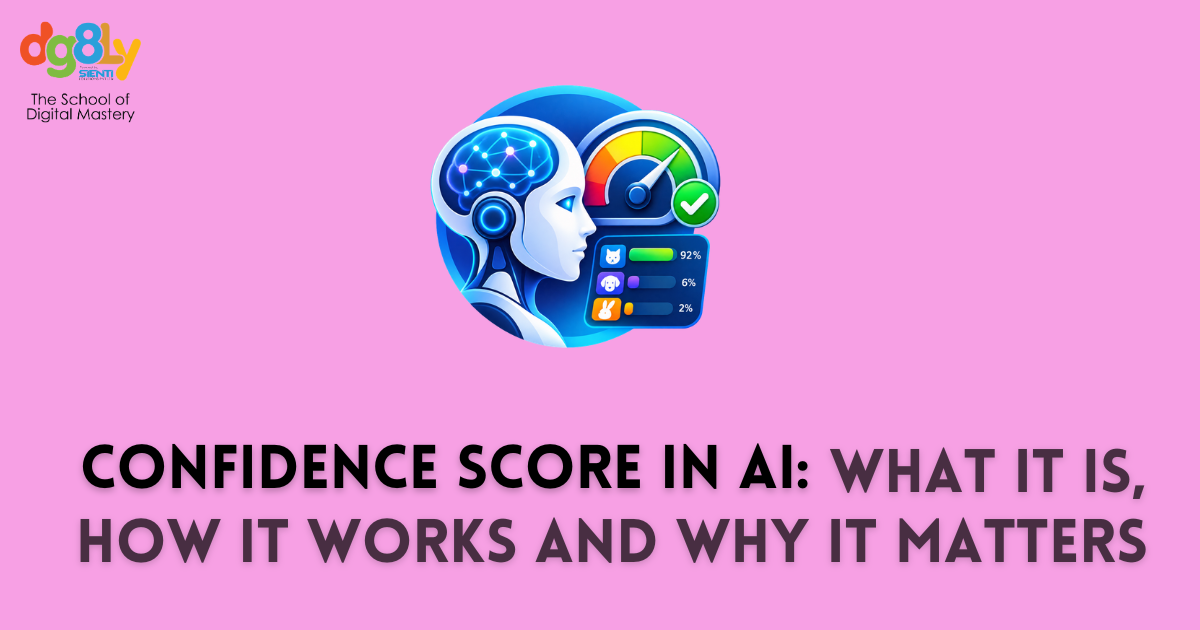
Confidence Score in AI: What It Is, How It Works, and Why It Matters
Artificial Intelligence (AI) is becoming an important part of our everyday lives. We interact with AI when using chatbots, voice assistants, recommendation platforms, search engines, image recognition tools, and many other digital applications. But when an AI system provides an answer or prediction, how do we know how certain it is?
This is where the Confidence Score in AI becomes useful.
A confidence score gives an indication of how strongly an AI model supports a particular prediction or result. For beginners, understanding this concept is important because it explains one of the ways AI systems evaluate possible outcomes.
What Is a Confidence Score in AI?
A Confidence Score in AI is a numerical value that represents how confident an AI model is about a particular prediction. It may be displayed as a percentage or as a value between 0 and 1, depending on the system.
For example, an image recognition system may analyze a picture and provide the following results:
Cat: 92%
Dog: 6%
Rabbit: 2%
In this example, the AI has given the highest score to “cat,” meaning it considers a cat the most likely identification.
However, a confidence score should not automatically be interpreted as a guarantee of correctness. A model can sometimes produce a highly confident prediction and still be wrong. The reliability of the score depends on the model, its training data, calibration, and the type of problem being solved.
How Does a Confidence Score Work in AI?
AI models learn patterns from data during training. When new information is provided, the model uses those learned patterns to generate possible predictions.
For example, imagine an AI email-filtering system. When a new email arrives, the system may analyze its words, sender information, links, and other signals.
It could produce:
Spam: 95%
Not Spam: 5%
The system may then classify the email as spam because the spam score is higher.
The exact process behind an AI confidence score differs between models and applications. Some systems produce probability-like values, while others produce scores that need to be calibrated before they can be interpreted as meaningful probabilities.
Why Is Confidence Score Important?
A confidence score gives users and businesses additional information about an AI prediction.
Instead of simply saying that an email is spam, an AI system can provide an indication of how strongly it supports that classification.
For example:
High confidence: The system may automatically process the result.
Medium confidence: The result may require additional checking.
Low confidence: The case may be sent to a human for review.
This makes confidence scores particularly useful in systems where automated decisions need to be combined with human oversight.
Confidence Score vs Accuracy
One common beginner mistake is assuming that confidence and accuracy mean the same thing. They do not.
Accuracy measures how often a model's predictions are correct across a particular evaluation dataset.
Confidence score indicates how strongly the model supports an individual prediction.
For example, an AI model could produce a prediction with a 95% confidence score and still be incorrect. Therefore, a high confidence score does not necessarily mean the model is 95% accurate.
This distinction is important when evaluating an AI model confidence level.
A Simple Example of AI Confidence Score
Suppose an AI system is designed to analyze customer reviews and classify them as positive, negative, or neutral.
A customer writes:
“The service was excellent, and I am very happy with my purchase.”
The AI could produce:
Positive: 97%
Neutral: 2%
Negative: 1%
The model has identified language that strongly suggests positive sentiment.
Now consider:
“The product was okay, but I expected better.”
The model might produce:
Positive: 45%
Neutral: 40%
Negative: 15%
Here, the AI has less certainty because the statement contains mixed sentiment.
This simple example shows how an AI prediction confidence level can vary depending on the information provided.
Where Are Confidence Scores Used?
Confidence scores can be found in many AI and machine learning applications.
1. Image Recognition
AI image recognition systems can use scores when identifying objects, animals, faces, or other elements within an image.
2. Speech Recognition
Voice assistants convert spoken language into text. Confidence-related measures can help systems determine how certain they are about what a person said.
3. Chatbots
AI chatbots can classify user questions and generate responses. In some applications, confidence levels can help determine whether a query should be handled automatically or transferred to a human agent.
4. Fraud Detection
Financial institutions can use AI systems to identify potentially suspicious transactions. A risk or confidence score can help determine whether additional verification is necessary.
5. Recommendation Systems
Shopping platforms, streaming services, and social media applications use AI to predict what users may find relevant or interesting. Scoring mechanisms help rank possible recommendations.
6. Digital Marketing
AI is increasingly used in SEO, content creation, customer segmentation, advertising, analytics, and personalization. Understanding AI predictions and confidence levels can help digital marketers make more informed decisions when working with AI-powered tools.
What Factors Affect an AI Confidence Score?
Several factors can influence an AI model's confidence.
Training Data
The quality, relevance, diversity, and completeness of training data can affect model performance.
Input Quality
Clear and relevant input generally makes prediction easier. Poor-quality, incomplete, or unusual information can make the model less reliable.
Model Design
Different machine learning and AI models use different methods to identify patterns and generate predictions.
Similarity to Training Data
An AI system may perform differently when presented with information that is very different from what it encountered during training.
Model Calibration
A model's confidence scores may need calibration so that the numerical scores better correspond to actual probabilities of being correct.
Can You Always Trust a High Confidence Score?
No.
A high confidence score does not automatically mean that an AI answer is correct. AI models can sometimes be confidently wrong.
This can happen because of limitations in the training data, unexpected inputs, biases, insufficient context, or situations that differ significantly from the data used to develop the model.
For important decisions, confidence scores should therefore be treated as one piece of information rather than absolute proof.
Human expertise and additional evidence may still be necessary.
How Businesses Can Use Confidence Scores
Businesses can use confidence scores to create smarter workflows.
For example, a customer support chatbot could automatically answer frequently asked questions when it has sufficient confidence. If the system is uncertain, it could transfer the conversation to a human support representative.
Similarly, an AI document-processing system could automatically handle straightforward documents while sending unusual or uncertain cases to employees for review.
This approach allows businesses to benefit from automation while maintaining appropriate human oversight.
Benefits of Confidence Scores in AI
Confidence scores can provide several benefits:
Help indicate the certainty of an AI prediction
Support automated workflows
Identify uncertain cases
Help prioritize human review
Improve monitoring of AI systems
Support better decision-making
Provide additional context around AI-generated results
However, confidence scores are most useful when businesses understand what the score represents and how reliable it is for their particular application.
The Future of AI Confidence Scores
As artificial intelligence becomes more widely used, understanding model uncertainty will become increasingly important.
Businesses are adopting AI for customer service, marketing, data analysis, automation, content creation, and decision support. In these applications, knowing when an AI system is confident and when it needs additional information or human review can improve the way AI is implemented.
For digital professionals, learning basic AI concepts such as confidence score in machine learning, model predictions, data quality, and AI limitations can provide a stronger foundation for working with modern AI-powered tools.
Frequently Asked Questions About Confidence Score in AI
What is a confidence score in AI?
A confidence score is a numerical indication of how strongly an AI model supports a particular prediction or classification. It is commonly represented as a percentage or a value between 0 and 1.
Is a 90% confidence score 90% accurate?
Not necessarily. A confidence score and model accuracy measure different things. A model can give a prediction with high confidence and still be incorrect.
How is an AI confidence score calculated?
The calculation depends on the AI or machine learning model being used. Different models use different mathematical methods to generate prediction scores, and these scores may require calibration before being interpreted as probabilities.
Why are confidence scores important in AI?
They can help users understand the uncertainty associated with AI predictions and can help businesses decide when to automate a task and when human review may be appropriate.
Where are AI confidence scores used?
They can be used in applications such as image recognition, speech recognition, chatbots, fraud detection, recommendation systems, classification, and other machine learning applications.
Can AI be confidently wrong?
Yes. AI systems can sometimes produce incorrect predictions with high confidence. This is why confidence scores should be interpreted alongside other evidence and appropriate human judgment.
Conclusion
The Confidence Score in AI is an important concept for understanding how artificial intelligence makes predictions. It provides an indication of how strongly an AI model supports a particular result, but it should not be treated as a guarantee that the prediction is correct.
From chatbots and image recognition to fraud detection and digital marketing, confidence scores can help organizations understand AI outputs and determine when human involvement may be necessary.
As AI continues to transform the digital landscape, learning how AI systems work can give professionals a valuable advantage. For anyone interested in SEO, content marketing, social media, advertising, analytics, and AI-powered marketing tools, enrolling in the best digital marketing course in Kochi can be a practical way to develop the skills needed for today's evolving digital industry.

