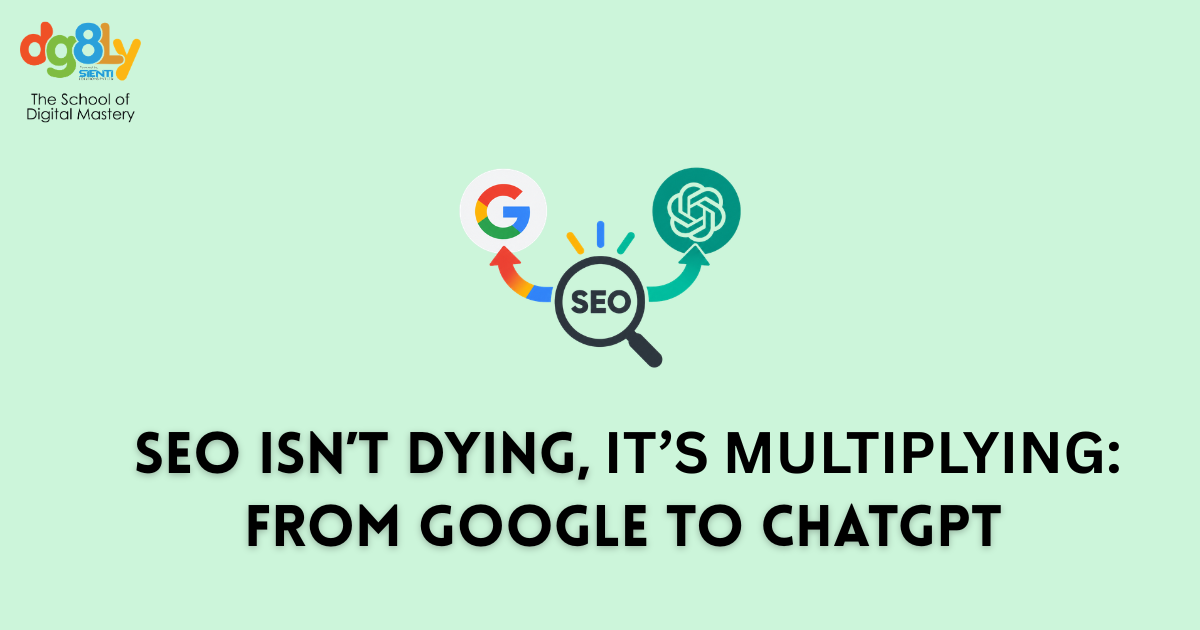
SEO Isn’t Dying, It’s Multiplying: From Google to ChatGPT
For years, when someone said SEO, most people thought about one thing: Google.
Businesses researched keywords, optimized websites, built backlinks, improved page speed and tried to get their pages onto the first page of Google.
But search behaviour is changing.
Today, people don't always start their search on Google.
They may
search on Bing
look for a tutorial on YouTube
ask real people on Reddit
ask an AI tool such as ChatGPT.
So, is SEO dying?
No. SEO is multiplying.
SEO is moving from being primarily about ranking on one search engine to being about making your brand, content and expertise discoverable across multiple search and discovery platforms.
What Does SEO Actually Mean?
SEO stands for Search Engine Optimization.
In simple terms, SEO means making your content easier for search systems to:
Find
Understand
Trust
Rank or recommend
Show to the right audience
Traditionally, we associated this process mainly with Google.
But the basic goal has not changed:
Be visible when someone is looking for what you offer.
What has changed is where people are looking.
1. Google: The Traditional Home of SEO
Google is still an extremely important part of SEO.
When someone searches:
"best digital marketing course in Kochi"
Google tries to understand the searcher's intent and provide useful results.
For businesses, traditional SEO still involves things such as:
Keyword research
Helpful content
Technical SEO
Website structure
Internal linking
Backlinks and authority
Local SEO
Page experience
Clear and trustworthy information
But Google is no longer the only place where your audience searches.
That is where the idea of search everywhere becomes important.
2. Bing: SEO Hasn't Disappeared, The Search Ecosystem Has Expanded
Bing is another important search platform.
While Google may dominate many search markets, Bing has its own search ecosystem and webmaster tools.
Interestingly, Microsoft's current webmaster guidance makes an important point: traditional SEO fundamentals such as crawlability, indexing, content clarity, structure, authority and trust also support visibility in Bing's AI-powered experiences.
This means that good SEO practices are becoming useful beyond traditional blue-link search results.
What should businesses do?
Don't create completely different content for every search engine.
Instead, create content that is:
Clear
Useful
Well structured
Technically accessible
Trustworthy
Relevant to the audience
Good SEO fundamentals can travel across platforms.
3. YouTube: SEO Is No Longer Just About Websites
Think about your own behaviour.
If you want to learn:
"How to change a car battery"
you might search Google.
But you might also go directly to YouTube.
If you want to learn:
"How to use Google Analytics"
you may prefer watching a video rather than reading a 2,000-word article.
That means YouTube has become an important search and discovery platform.
YouTube itself says its search system considers factors including relevance, engagement and quality. It also considers how well elements such as the title, description and video content match a viewer's query.
So video content needs optimization too.
For example:
YouTube SEO can involve:
Understanding what people search for
Creating useful video titles
Writing descriptive descriptions
Using relevant keywords naturally
Creating compelling thumbnails
Structuring videos around user intent
Improving watch time and viewer satisfaction
Building topical authority through consistent content
This is still SEO.
The difference is that you are optimizing video content instead of just web pages.
4. Reddit: People Are Searching for Human Experiences
Now comes an interesting shift.
People don't always want a polished article written by a company.
Sometimes they want to know:
"Has anyone actually tried this?"
"Is this product worth buying?"
"What problems did you face?"
"Which course is actually good?"
"What should I know before doing this?"
This is where communities such as Reddit can become valuable.
Reddit is different from Google because much of its value comes from real conversations and experiences.
Someone may search Google for:
"Best camera for beginners"
But they may then go to Reddit to ask:
"Which camera did you actually buy, and would you buy it again?"
This creates another form of search visibility.
Reddit SEO isn't about spamming links.
It is about participating in relevant conversations and contributing genuinely useful information.
Businesses can learn from Reddit by understanding:
What questions people repeatedly ask
What problems customers experience
What language customers actually use
What products people compare
What objections people have
What information is missing from existing content
Reddit can therefore become both a research source and a discovery channel.
5. ChatGPT: Search Is Becoming Conversational
The biggest change for many people is the rise of AI-powered search.
Instead of typing:
"best restaurants Kochi"
someone might ask:
"I'm staying in Kakkanad and want a good restaurant for a family dinner. Which places would you recommend?"
The search becomes conversational.
ChatGPT can search the web for current information and provide answers with relevant sources.
This creates a new question for businesses:
How can I make my business or content more likely to be discovered when people ask AI systems questions?
This is where terms such as GEO (Generative Engine Optimization) and AI search optimization are becoming increasingly relevant.
But don't make the mistake of thinking that AI search means traditional SEO is finished.
In fact, Bing's current guidance explicitly says that many traditional SEO fundamentals also support eligibility for AI-generated experiences and citations.
From Keywords to Questions
Traditional SEO often starts with:
"What keyword should I rank for?"
Modern search strategy should also ask:
"What questions is my audience asking?"
For example, imagine you run a digital marketing institute.
Instead of targeting only:
"digital marketing course Kochi"
you could create useful content around questions such as:
What is digital marketing?
Is digital marketing a good career?
How long does it take to learn SEO?
What does an SEO specialist do?
How can a small business get more Google traffic?
How does local SEO work?
What is the difference between SEO and Google Ads?
How can businesses appear in AI search results?
Now your content can potentially serve people at different stages of their journey.
SEO Is Becoming Search Everywhere Optimization
This is the bigger picture.
Think about the evolution:
Google → Bing → YouTube → Reddit → ChatGPT
These aren't identical platforms.
Each has different algorithms, audiences and content formats.
But they have something in common:
People use them to discover information.
That means marketers need to stop thinking only about:
"How do I rank my website?"
and start thinking:
"How do I make my brand discoverable wherever my audience searches?"
One Topic Can Become Many Pieces of Content
Suppose your business sells running shoes.
Instead of creating only one SEO article called:
"Best Running Shoes for Beginners"
you could build an entire search ecosystem.
Create a detailed comparison article.
Bing
Make sure your website is crawlable, structured and technically sound.
YouTube
Create:
"5 Best Running Shoes for Beginners"
Participate in relevant discussions and understand what runners actually struggle with.
ChatGPT and AI Search
Create accurate, well-structured and genuinely useful information that clearly explains your products, expertise and comparisons.
One subject can therefore become a content ecosystem.
Does This Mean Traditional SEO Is Dead?
Absolutely not.
In fact, the fundamentals may become even more important.
Search systems need to discover and understand information.
They need signals that help determine whether information is useful and trustworthy.
They need context.
They need authoritative sources.
They need clearly structured content.
So the future isn't:
SEO vs AI
It is more like:
SEO + Content + Video + Communities + AI Search
The tactics may change, but the fundamental objective remains the same:
Help the right people find the right information.
What Should Beginners Learn?
If you're just starting SEO, don't try to learn every platform separately on day one.
Start with the fundamentals.
Step 1: Understand Search Intent
Learn why someone is searching.
Are they:
Looking for information?
Comparing products?
Looking for a specific business?
Ready to buy?
Trying to solve a problem?
Understanding intent is more valuable than simply inserting keywords.
Step 2: Learn Keyword Research
Keywords still matter.
But don't focus only on high-volume keywords.
Look for:
Questions
Problems
Long-tail searches
Local searches
Comparisons
Buying intent
Step 3: Learn Content Strategy
Learn how to create content that actually answers people's questions.
Don't create content simply because a keyword has search volume.
Create it because someone needs the information.
Step 4: Learn Technical SEO
Understand the basics of:
Crawling
Indexing
Site structure
URLs
Sitemaps
Internal links
Page performance
Structured data
These fundamentals remain important across search ecosystems.
Step 5: Expand Beyond Google
Once you understand traditional SEO, explore:
YouTube SEO
Local SEO
Social search
Community-driven discovery
AI search
Generative Engine Optimization
You don't need to become an expert in everything immediately.
But you should understand how search behaviour is changing.
The SEO Professional of the Future
The SEO professional of the future may not spend all day looking at Google rankings.
They may ask:
- Where is my audience searching?
- What questions are they asking?
- What content format do they prefer?
- Are people discovering my brand through videos?
- Are communities discussing my industry?
- Can AI systems understand my content?
- Is my brand being mentioned and recommended across different platforms?
This is a much bigger role than traditional keyword optimization.
SEO is becoming a combination of search strategy, content strategy, technical optimization, brand authority and audience understanding.
SEO Isn't Dying. It's Multiplying.
The biggest mistake would be to think that the emergence of AI means SEO is going away.
Search is not disappearing.
Search is expanding.
People are searching on Google.
They are searching on Bing.
They are searching YouTube.
They are looking for opinions and experiences on Reddit.
And increasingly, they are asking AI systems such as ChatGPT to find, understand and summarize information.
The platforms may change.
The algorithms may change.
The way people formulate their questions may change.
But one https://www.instagram.com/cherishlife_deepa?stkn=MTF3MzMxbjR0Z2RhdQ==thing remains constant:
Businesses need to be discoverable.
And that is why SEO isn't dying.
SEO is multiplying.
For beginners and marketers, the opportunity is not to abandon SEO but to learn how search is evolving, from traditional search engines to video platforms, communities and AI-powered search.
Conclusion
The future of SEO isn't about choosing between Google and ChatGPT. It is about understanding the entire search and discovery ecosystem.
Learn the fundamentals of SEO first. Then learn how those fundamentals can be applied to websites, Bing, YouTube, communities such as Reddit and emerging AI search experiences.
If you want to build a career in digital marketing, understanding this shift can give you a major advantage. The SEO professional of tomorrow will need to think beyond rankings and understand how people discover information across platforms.
If you're looking to develop these skills through practical learning, a best SEO course in Kochi should go beyond traditional keyword research and Google rankings. It should help you understand technical SEO, content strategy, local SEO, video discovery, search intent and the changing world of AI-powered search.
SEO isn't disappearing. It is expanding and the smartest marketers will expand with it.

